






Tube Art Group: Where Industry Meets Artistry

If you’ve ever driven past the iconic pink Elephant Car Wash sign that lit up Seattle’s Denny Way for decades, you’ve seen the work of Tube Art Group. That beloved neon landmark—now preserved in a museum—was crafted by the largest family-owned, full-service sign company in the Pacific Northwest.
For nearly 80 years, Tube Art has helped shape the region’s visual identity, one standout sign at a time.
Founded in 1946 by Frank Dupar Sr. and Harry Simon, Tube Art emerged in a post-WWII Seattle that lacked an abundance of professional sign-making businesses. “The big neon sign shops were in L.A. and San Francisco,” said Francis Dupar, Tube Art President and great-grandson of Frank Dupar Sr. “Our great grandfather wanted to bring the same level of craftsmanship to Seattle.”
From the beginning, the company was built on a commitment to excellence, employing top-tier salespeople, designers and installers to turn out a world-class product.
Today, Tube Art operates out of Bellevue, Wash., with production facilities in Yakima, Wash., and Auburn, Wash. Their team of approximately 150 employees creates signage for companies across the U.S., but their focus remains Washington and Oregon. From the world’s largest coffee company to the biggest sports venues in Seattle, their client roster is a who’s who of well-known brands. Their work spans illuminated exterior signs, environmental graphics, ADA-compliant wayfinding systems and everything in between.
For example, when a company updates its typography, Tube Art is brought in to refresh the signage at every touchpoint, from exterior signage to vinyl door decals with the business’s name and hours. Whether it’s a corporate campus or a hospital, this type of visual communication matters—it reinforces a brand’s professionalism and credibility. As James Dupar, brother to Francis and Tube Art Executive Vice President, notes, “You only get one chance to make a first impression.”
The Dupar brothers didn’t always plan to join the family business. “We both went to college and Dad said, ‘Hey, come work at Tube Art, just to see how you like it,’” James recalled. “I fell in love with it—the people, the industry, the finished product.”
Added Francis, “Not a lot of people want to leave the industry once they’re in it. You work on interesting projects with interesting clients and it’s always a positive vibe.”
The company’s collaborative culture is key to its ongoing success. Many employees have been with the company for decades, including one who recently retired after 48 years. “Collaboration is definitely core to how we work,” said James. “We have a group of very bright, talented folks who help us lead in our industry.”
Over the years, Tube Art has evolved with technology. The shift from neon and fluorescent lighting to energy-efficient LEDs has transformed the industry. Advances in printing and graphic design have also made their workflow more efficient. “You see these old hand-drawn sketches with scale dimensions—they’re amazing,” James said. “Now you can do all that digitally, and it’s changed everything.”
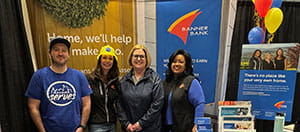
“Banner has been so great to us,” Francis said. “You’re working with a community bank, so you’re not just some number to someone in New York—you matter.” James added, “The personal relationship isn’t as common anymore, but it’s serious and it means something. Banner is still doing business the right way.”
As Tube Art Group approaches its 80th anniversary in 2026, the company continues to blend legacy with innovation—lighting up the West with signs that shape skylines.
“The craftsmanship Tube Art puts into their work is incredible,” says Raymond Baer, VP and Senior Commercial Relationship Manager. “We congratulate them on approaching 80 years in business. We are so proud to work with them and look forward to helping them continue to excel."
-
 Western Records Destruction at 40: A Legacy of Security and Service<i class="fa fa-chevron-right"></i>
 -
 Smith-Root: Powering Innovation in Aquatic Science<i class="fa fa-chevron-right"></i>
 -
 Hermiston Drug: A Meeting Place for Generations<i class="fa fa-chevron-right"></i>
 -
 Tacoma Rainiers: Knocking It Out of the Park for Fans<i class="fa fa-chevron-right"></i>
 -
 ElliptiGO: Reinventing Fitness for the Long Run<i class="fa fa-chevron-right"></i>